

We have all been there: staring at a screen, waiting for a One-Time Password (OTP) that never arrives, or finally pops up three minutes after the session has timed out. When an OTP gets delayed, it is rarely a random glitch. It is a fundamental deliverability failure. Whether it is an email getting throttled by an ISP or an SMS getting stuck in a telecom bottleneck, the result is the same: frustrated users, abandoned logins, and lost revenue.
If your authentication flow is suffering from high latency, the root cause almost always points back to your service provider’s infrastructure. Here is exactly why these delays happen and what you must look for when choosing a provider to ensure your system never leaves users waiting.
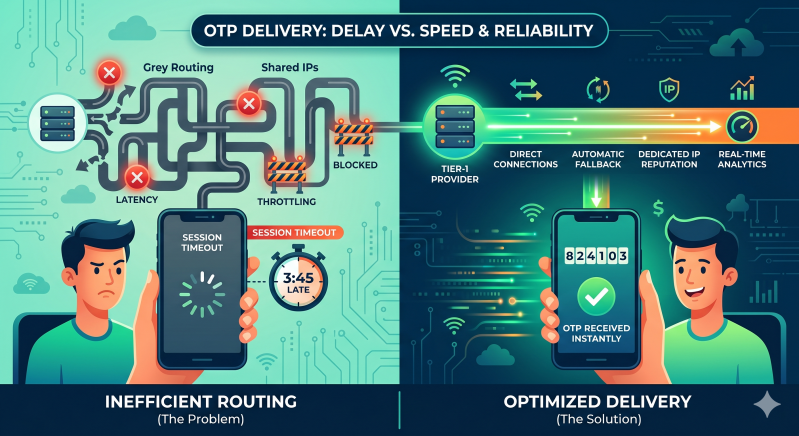
Why Do OTP Delays Happen?
The journey of an OTP code is measured in milliseconds, but several roadblocks can cause severe delays:
-
"Grey" Routing (SMS): Many cheap SMS providers use unapproved, multi-hop routes to save money. These messages bounce between different aggregators before reaching the local telecom operator, which frequently filters, throttles, or drops them entirely.
-
Shared IP Pools (Email): If you are sending email OTPs from a shared IP address, your critical authentication codes are sharing a reputation with every other sender on that server. If a neighbor sends a poorly formatted marketing blast, ISPs like Gmail or Outlook will throttle the entire IP, delaying your OTPs.
-
Poor Infrastructure & High Latency: Providers lacking localized data centers or cloud redundancy simply cannot process requests fast enough during peak traffic hours.
-
Zero Fallback Logic: When a primary carrier or email node fails, poorly built systems just keep retrying a dead end instead of seamlessly switching to an alternate route.
What to Look for in a Bombproof OTP Provider
To safeguard your authentication system, you need to look past the marketing claims and interrogate the provider's actual deliverability mechanics. Here is the checklist:
1. Direct Operator Connections (For SMS)
Do not settle for aggregators who buy cheap traffic. Your provider must have Tier-1, direct connections to local telecom operators. Direct routes mean your message goes straight into the local network, achieving sub-5-second delivery speeds and avoiding aggressive spam filters.
2. Dedicated or Strictly Segregated Transactional IPs (For Email)
Never mix marketing emails with authentication emails. Your provider should offer either dedicated IP addresses with guided warm-up protocols or strictly monitored transactional-only IP pools. This ensures your sender reputation remains pristine and your codes bypass the promotions tab entirely.
3. Intelligent Routing and Automatic Fallback
A robust provider does not rely on a single point of failure. Look for platforms that feature automatic channel failover. If an SMS code is not delivered within 3 to 5 seconds, the system should automatically trigger a fallback, such as sending an email OTP or initiating a voice call, without the user needing to click "Resend."
4. Hard SLAs and Real-Time Analytics
If you cannot see the bottleneck, you cannot fix it. Avoid providers that only give you "Sent" statuses. You need deep, real-time analytics showing carrier-level delivery receipts, bounce codes, and precise latency metrics. Furthermore, ensure their Service Level Agreement (SLA) guarantees 99.9% uptime and penalizes them for delayed delivery.
5. Scalability Without Throttling
Your verification traffic will inevitably spike during product launches or peak hours. Ensure the provider has auto-scaling architecture that can absorb sudden volume surges without queuing your messages and increasing latency.
An OTP has a shelf life of seconds. Security and speed are entirely dependent on deliverability. Treat your OTP infrastructure as a mission-critical pipeline, invest in direct routes, protect your sender reputation, and demand absolute transparency from your provider.
Add comment
Comments